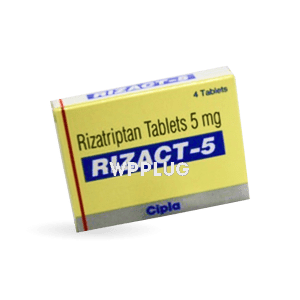
| Product dosage: 10mg | |||
|---|---|---|---|
| Package (num) | Per pill | Price | Buy |
| 8 | $8.03 | $64.21 (0%) | 🛒 Add to cart |
| 12 | $7.44 | $96.32 $89.30 (7%) | 🛒 Add to cart |
| 24 | $6.94 | $192.64 $166.56 (14%) | 🛒 Add to cart |
| 36 | $6.52 | $288.96 $234.78 (19%) | 🛒 Add to cart |
| 60 | $6.12 | $481.61 $367.23 (24%) | 🛒 Add to cart |
| 88 | $5.81
Best per pill | $706.36 $511.71 (28%) | 🛒 Add to cart |
| Product dosage: 5mg | |||
|---|---|---|---|
| Package (num) | Per pill | Price | Buy |
| 8 | $6.40 | $51.17 (0%) | 🛒 Add to cart |
| 12 | $6.02 | $76.76 $72.24 (6%) | 🛒 Add to cart |
| 24 | $5.60 | $153.51 $134.45 (12%) | 🛒 Add to cart |
| 36 | $5.21 | $230.27 $187.63 (19%) | 🛒 Add to cart |
| 60 | $4.82 | $383.78 $288.96 (25%) | 🛒 Add to cart |
| 88 | $4.62
Best per pill | $562.88 $406.36 (28%) | 🛒 Add to cart |
Rizact: Advanced Relief from Acute Migraine Attacks
Rizact, containing the active ingredient Rizatriptan Benzoate, is a prescription medication specifically formulated for the acute treatment of migraine with or without aura in adults. It belongs to the class of drugs known as selective serotonin (5-HT1B/1D) receptor agonists, or triptans. This medication is not intended for the prophylactic management of migraine or for the treatment of cluster headaches. Rizact works by narrowing blood vessels around the brain and blocking the release of natural substances that cause migraine pain, nausea, sensitivity to light and sound, and other associated symptoms, providing targeted and effective relief.
Features
- Active Ingredient: Rizatriptan Benzoate (10 mg per tablet)
- Drug Class: Selective Serotonin 5-HT1B/1D Receptor Agonist (Triptan)
- Administration: Oral, orally disintegrating tablet (ODT) and standard film-coated tablet formulations
- Onset of Action: Pain relief can begin as soon as 30 minutes to 2 hours post-dose
- Bioavailability: Approximately 45%, with absorption unaffected by food
- Half-life: Approximately 2-3 hours
- Metabolism: Primarily via monoamine oxidase-A (MAO-A) isoenzyme
- Excretion: Primarily renal (via urine)
Benefits
- Provides rapid and effective relief from the debilitating pain of a migraine attack.
- Effectively reduces or eliminates associated migraine symptoms, including nausea, vomiting, photophobia (sensitivity to light), and phonophobia (sensitivity to sound).
- Helps restore normal function, allowing for a quicker return to daily activities, work, and social engagements.
- Offers a convenient and portable oral dosage form, with an orally disintegrating option for those who have difficulty swallowing tablets or experience significant nausea.
- Provides a targeted mechanism of action, specifically addressing the complex pathophysiology of a migraine attack rather than offering generalized pain relief.
Common use
Rizact is indicated for the acute treatment of migraine with or without aura in adults. It is most effective when taken at the very onset of migraine symptoms. It is not to be used for the treatment of hemiplegic or basilar migraine. A migraine attack is typically characterized by a moderate to severe, often pulsating, unilateral headache that is aggravated by routine physical activity and is accompanied by autonomic symptoms. Rizact is used to abort an ongoing attack; it is not a cure for migraines and will not reduce the number of attacks experienced.
Dosage and direction
The recommended dose is a single 10 mg tablet. If the migraine headache returns, a second dose may be taken after at least 2 hours have passed since the first dose. The maximum dose in a 24-hour period should not exceed 30 mg. For patients on prophylactic propranolol therapy, a dose reduction to 5 mg of Rizact is recommended, with a maximum daily dose of 15 mg. The tablet should be taken with a full glass of water. The orally disintegrating tablet (ODT) should be placed on the tongue, where it will disintegrate and be swallowed with saliva; no liquid is needed to take the ODT.
Precautions
- Rizact should only be used where a clear diagnosis of migraine has been established.
- This drug should not be used in patients with unrecognized coronary artery disease (CAD) without a prior cardiovascular evaluation.
- Use with caution in patients with risk factors for coronary artery disease (e.g., hypertension, hypercholesterolemia, smoking, obesity, diabetes, strong family history, postmenopausal women, or males over 40) unless a cardiovascular evaluation provides satisfactory evidence that the patient is free of underlying cardiovascular disease.
- Sensations of tightness, pain, pressure, and heaviness in the precordium, throat, neck, and jaw commonly occur after treatment with triptans and are usually non-cardiac in origin. However, if such sensations are severe, or are consistent with angina, perform a cardiac evaluation.
- May cause cerebrovascular events (e.g., stroke, hemorrhage, transient ischemic attack), other vasospasm-related events (e.g., peripheral vascular ischemia, gastrointestinal vascular ischemia and infarction, Raynaud’s syndrome), and increased blood pressure.
- Serotonin syndrome may occur with triptans, particularly during concomitant use with serotonergic drugs.
Contraindications
- History of ischemic heart disease (e.g., angina pectoris, history of myocardial infarction, or documented silent ischemia).
- Coronary artery vasospasm, including Prinzmetal’s angina.
- Uncontrolled hypertension.
- History of stroke or transient ischemic attack (TIA).
- Peripheral vascular disease.
- Ischemic bowel disease.
- Hemiplegic or basilar migraine.
- Hypersensitivity (allergy) to Rizatriptan Benzoate or any component of the formulation.
- Concurrent administration or within 2 weeks of discontinuing an MAO-A inhibitor.
- Concurrent administration of other 5-HT1 agonists (e.g., other triptans) or ergotamine-containing or ergot-type medications (e.g., dihydroergotamine, methysergide) within 24 hours.
Possible side effect
Very Common (>10%) and Common (1-10%):
- Dizziness, drowsiness, fatigue.
- Nausea.
- Pain or pressure sensations in the chest, neck, throat, or jaw (often non-cardiac).
- Palpitations, tachycardia.
Uncommon (0.1-1%):
- Dry mouth.
- Flushing, feeling of warmth.
- Hypertension, hypotension.
- Muscle weakness, stiffness, or cramps.
Rare (<0.1%):
- Myocardial ischemia, angina pectoris.
- Bradycardia, arrhythmias.
- Syncope (fainting).
- Allergic reactions (rash, urticaria, pruritus).
- Serotonin syndrome (agitation, hallucinations, coma, tachycardia, labile blood pressure, hyperthermia, hyperreflexia, incoordination, nausea, vomiting, diarrhea).
Drug interaction
- MAO-A Inhibitors: Contraindicated. Concomitant use significantly increases the systemic exposure (AUC) of Rizatriptan. Do not use within 2 weeks of discontinuing an MAO-A inhibitor.
- Propranolol: Increases the AUC of Rizatriptan by approximately 70%. The dose of Rizact should be reduced to 5 mg in patients taking propranolol, with a maximum daily dose of 15 mg.
- Other Triptans and Ergot Derivatives: Contraindicated within 24 hours of each other due to a theoretical increased risk of prolonged vasospastic reactions.
- Selective Serotonin Reuptake Inhibitors (SSRIs) and Serotonin-Norepinephrine Reuptake Inhibitors (SNRIs): Concomitant use may potentially increase the risk of serotonin syndrome. Monitor patients closely.
- Other 5-HT1 Agonists.
Missed dose
Rizact is not scheduled for regular daily use. It is taken on an as-needed basis at the onset of a migraine headache. Therefore, the concept of a “missed dose” does not apply. Do not take a double dose to make up for a dose you think you should have taken earlier in the day.
Overdose
There is limited clinical experience with Rizatriptan overdose. Symptoms of overdose may include dizziness, drowsiness, fainting, tachycardia, bradycardia, hypotension, hypertension, vomiting, and loss of coordination. In cases of suspected overdose, standard supportive measures should be instituted. The patient’s ECG and vital signs should be monitored. Rizatriptan is not effectively removed by hemodialysis.
Storage
- Store at room temperature (20°C to 25°C or 68°F to 77°F). Excursions are permitted between 15°C and 30°C (59°F and 86°F).
- Protect from light and moisture.
- Keep the blister strips in the outer carton until the time of use.
- For the orally disintegrating tablets (ODT): Keep the blister package dry. Handle the tablet with dry hands and place it on the tongue immediately upon opening the blister.
- Keep all medications out of the reach of children and pets.
Disclaimer
This information is for educational and informational purposes only and does not constitute medical advice. It is not a substitute for professional medical advice, diagnosis, or treatment. Always seek the advice of your physician or other qualified health provider with any questions you may have regarding a medical condition or before starting any new treatment. Never disregard professional medical advice or delay in seeking it because of something you have read here. The information provided is based on the drug’s prescribing information but may not be exhaustive.
Reviews
- “As a long-time migraine sufferer, Rizact has been a game-changer. The ODT formulation is a lifesaver when I’m too nauseous to swallow a pill. Relief typically begins within 45 minutes for me.” – Sarah K., 42
- “I’ve tried several triptans, and Rizact 10mg provides the most consistent and complete relief with the fewest side effects. The chest tightness I experienced with other medications is minimal with this one.” – Mark T., 38
- “Effective, but it does make me quite drowsy. I have to plan to be able to rest for an hour or two after taking it. It reliably aborts my migraines, so the trade-off is worth it for me.” – Jennifer L., 51
- “My neurologist prescribed this after other options failed. It works well about 80% of the time. When it doesn’t work fully, it at least takes the pain down to a manageable level.” – David R., 29
- “Quick dissolving tablet is very convenient. The effect is fast, but I do sometimes experience a ‘rebound’ headache the next day. My doctor and I are managing this.” – Priya S., 35