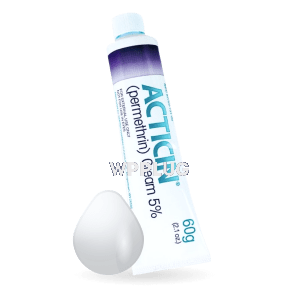
Acticin: Targeted Relief from Persistent Scabies Infestations
Acticin (permethrin) 5% cream is a topical scabicidal medication formulated for the eradication of Sarcoptes scabiei var. hominis, the mite responsible for human scabies. As a synthetic pyrethroid, it exhibits potent insecticidal and ovicidal activity, disrupting the sodium channel function in the parasite’s nervous system, leading to paralysis and death. Its low mammalian toxicity profile and high efficacy against all stages of the mite life cycle—including eggs, larvae, and adults—make it a first-line therapeutic choice recommended by dermatologists and infectious disease specialists worldwide. Proper application is crucial for achieving complete parasitological cure and resolving the intense pruritus and cutaneous manifestations associated with the infestation.
Features
- Contains 5% permethrin as the active pharmaceutical ingredient.
- Formulated in a water-washable, odorless cream base for ease of application.
- Exhibits both insecticidal (kills mites) and ovicidal (kills eggs) properties.
- Typically supplied in 60-gram tubes, sufficient for one full adult treatment.
- Demonstrates a low potential for systemic absorption when used topically as directed.
- Remains stable at room temperature, with a standard shelf life of 24-36 months.
Benefits
- Provides highly effective eradication of scabies mites, achieving cure rates exceeding 95% with correct use.
- Rapidly alleviates the severe, debilitating itching (pruritus) that characterizes scabies infestations.
- Significantly reduces the risk of secondary bacterial skin infections (e.g., impetigo, cellulitis) by resolving the primary infestation and excoriations from scratching.
- Helps prevent the transmission of scabies to close contacts and household members, curtailing community spread.
- Minimizes the psychosocial distress and social stigma often associated with visible scabies lesions.
- Offers a well-tolerated treatment option with a favorable safety profile for most patient populations, including children over two months of age.
Common use
Acticin cream is primarily indicated for the treatment of scabies. Scabies is a highly contagious skin infestation transmitted through prolonged direct skin-to-skin contact or, less commonly, through contact with contaminated fomites like bedding, clothing, or towels. It presents with a classic symptom triad of intense pruritus (often worse at night), burrows (short, wavy, grayish-white lines on the skin surface), and a papulovesicular rash. Common sites of involvement include the interdigital web spaces, wrists, elbows, axillae, waist, genitalia, and buttocks. The cream is applied from the neck down to the soles of the feet, covering the entire body surface area. It is also used in the management of crusted (Norwegian) scabies, a severe, hyperkeratotic form of the disease, though often as part of a more aggressive combination treatment regimen under strict medical supervision.
Dosage and direction
For the treatment of scabies in adults and children aged 2 months and older:
- Thoroughly wash and dry the entire body. The cream is best applied after a warm shower or bath, as this may facilitate the opening of burrows.
- Shake the tube well before use.
- Apply a thin layer of Acticin cream to clean, dry skin from the neck down to the soles of the feet, covering every inch of the body surface. Pay particular attention to areas where mites commonly reside: between the fingers and toes, in the folds of the wrists, elbows, and knees, the axillae, the waistline, the navel, the buttocks, the genital area, and under the fingernails and toenails (which should be trimmed short).
- Gently massage the cream into the skin until it is no longer visible.
- Leave the cream on for 8 to 14 hours (typically overnight is most practical).
- After this treatment period, thoroughly wash off the cream by taking a shower or bath and drying with a clean towel.
- Put on clean clothing and use freshly laundered bedding and towels.
- A single application is usually sufficient. A second application, one week after the first, may be recommended by a physician in cases of severe, crusted scabies or if new burrows or rash appear after the initial treatment.
Precautions
- For external use only. Acticin must not be taken orally or applied to the eyes, nose, mouth, mucous membranes, or urethral meatus. If accidental contact with eyes occurs, flush with copious amounts of water.
- Contact with the cream should be avoided by individuals other than the patient to prevent unintended exposure.
- If significant irritation or sensitization develops during use, the cream should be washed off immediately and not reapplied. A physician should be consulted.
- The hands should not be washed after application. If hands must be washed for any reason during the treatment period, the cream must be reapplied to the hands immediately afterward.
- Launder all recently worn clothing, bedding, and towels in hot water and dry using the hot cycle of a dryer, or dry-clean them. Items that cannot be washed should be sealed in a plastic bag for at least 72 hours to kill any mites.
- Inform your doctor if you are pregnant, planning to become pregnant, or are breastfeeding. While topical permethrin is generally considered safe, the risk-benefit ratio should be evaluated by a healthcare professional.
Contraindications
Acticin cream is contraindicated in patients with a known history of hypersensitivity to permethrin, any other synthetic pyrethroid or pyrethrin, or to any of the inactive ingredients in the cream formulation. Cross-sensitivity between pyrethroids may occur.
Possible side effect
While generally well-tolerated, the following side effects may occur:
- Common (affecting >1% of users): Temporary itching, burning, stinging, tingling, or numbness at the application site; mild erythema (redness) or rash; and increased pruritus initially after treatment. This transient pruritus is often a response to the dying mites and is not necessarily an indication of treatment failure or allergy.
- Less common: Skin edema (swelling), skin irritation presenting as scaling or dryness, and a mild, transient rash.
- Rare: Allergic contact dermatitis, skin discoloration, and skin tenderness. Systemic reactions are exceedingly rare due to minimal absorption but could include headache, dizziness, nausea, or abdominal pain.
Drug interaction
Formal drug interaction studies have not been conducted with topical permethrin due to its negligible systemic absorption. There are no known clinically significant pharmacokinetic interactions with other medications. However, the concurrent use of other topical medications, especially those that are abrasive, peeling, or highly irritating (e.g., topical retinoids, keratolytics like salicylic acid), on the same treatment area should be avoided as it may increase skin irritation and systemic absorption potential.
Missed dose
This medication is typically used as a single, one-time application. It is not a medication used on a daily dosing schedule. If the application is washed off prematurely (e.g., less than 8 hours after application), it may reduce the efficacy of the treatment. Consult a physician or pharmacist for advice. Do not apply a double amount to make up for a prematurely washed-off dose.
Overdose
Overdose from topical application is unlikely due to low systemic absorption. However, excessive application could theoretically lead to increased systemic exposure, potentially increasing the risk of adverse effects. Signs of pyrethroid toxicity, though highly improbable, could include nausea, vomiting, headache, dizziness, fatigue, and in severe cases, muscular fasciculations or seizures. In case of accidental ingestion, seek emergency medical attention immediately. Treatment is supportive and symptomatic.
Storage
- Store Acticin cream at room temperature, between 20°C to 25°C (68°F to 77°F). Brief excursions outside this range are permitted.
- Keep the tube tightly closed in its original carton to protect from light and moisture.
- Do not freeze.
- Keep this and all medications out of the reach of children and pets to prevent accidental ingestion.
- Do not use the cream after the expiration date printed on the packaging.
Disclaimer
This information is intended for educational and informational purposes only and does not constitute medical advice. It is not a substitute for professional medical advice, diagnosis, or treatment. Always seek the advice of your physician, dermatologist, or other qualified health provider with any questions you may have regarding a medical condition or before starting any new treatment. Never disregard professional medical advice or delay in seeking it because of something you have read here. The efficacy and safety profile described may not be applicable to every individual.
Reviews
- “As a general practitioner, I have prescribed Acticin for over a decade. It remains my go-to first-line treatment for classic scabies. When applied meticulously by the patient, the success rate is exceptional. Patient education on the full-body application is key to preventing treatment failure.” – Dr. Eleanor Vance, MD
- “After my child contracted scabies at school, our pediatrician recommended Acticin. The itching was intense for the first 24 hours after washing it off, which we were warned about, but it subsided quickly. One treatment was all it took for the entire family to be clear. The instructions were very clear.” – Sarah J.
- “I treat complex dermatological cases, including crusted scabies in immunocompromised patients. While these cases often require oral ivermectin in combination therapy, topical permethrin (Acticin) is an indispensable component of the treatment protocol for its direct ovicidal action.” – Dr. Ben Carter, Dermatologist
- “I was initially skeptical because of a previous treatment failure with another product. My pharmacist explained the importance of applying it everywhere, even under nails and between toes. I followed the instructions to the letter, and it worked completely. The relief from the constant itching was immense.” – Mark T.