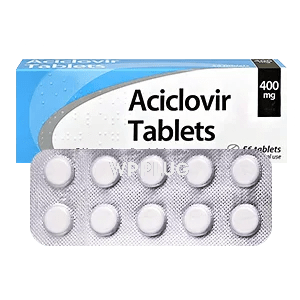
| Product dosage: 200mg | |||
|---|---|---|---|
| Package (num) | Per pill | Price | Buy |
| 60 | $0.74 | $44.24 (0%) | 🛒 Add to cart |
| 90 | $0.61 | $66.37 $55.30 (17%) | 🛒 Add to cart |
| 120 | $0.55 | $88.49 $66.37 (25%) | 🛒 Add to cart |
| 180 | $0.48 | $132.73 $86.48 (35%) | 🛒 Add to cart |
| 270 | $0.44 | $199.10 $118.65 (40%) | 🛒 Add to cart |
| 360 | $0.42
Best per pill | $265.46 $150.83 (43%) | 🛒 Add to cart |
| Product dosage: 400mg | |||
|---|---|---|---|
| Package (num) | Per pill | Price | Buy |
| 30 | $1.58 | $47.26 (0%) | 🛒 Add to cart |
| 60 | $1.04 | $94.52 $62.34 (34%) | 🛒 Add to cart |
| 90 | $0.85 | $141.78 $76.42 (46%) | 🛒 Add to cart |
| 120 | $0.75 | $189.04 $89.49 (53%) | 🛒 Add to cart |
| 180 | $0.66 | $283.56 $118.65 (58%) | 🛒 Add to cart |
| 270 | $0.60 | $425.34 $161.89 (62%) | 🛒 Add to cart |
| 360 | $0.57
Best per pill | $567.12 $204.12 (64%) | 🛒 Add to cart |
Aciclovir: Effective Antiviral Treatment for Herpes Infections
Aciclovir is a nucleoside analogue antiviral medication that has revolutionized the management of herpesvirus infections since its development in the 1970s. As a selective inhibitor of viral DNA polymerase, aciclovir demonstrates potent activity against herpes simplex virus types 1 and 2 (HSV-1, HSV-2), varicella-zoster virus (VZV), and Epstein-Barr virus. The medication achieves therapeutic efficacy through its unique mechanism of viral thymidine kinase activation, which enables targeted action against infected cells while minimizing impact on healthy host cells. Clinical evidence supports its use across multiple formulations including oral tablets, topical creams, intravenous solutions, and ophthalmic preparations.
Features
- Selective phosphorylation by viral thymidine kinase enables targeted antiviral activity
- Competitive inhibition of viral DNA polymerase prevents viral replication
- Available in multiple formulations: 200mg, 400mg, and 800mg oral tablets; 5% topical cream; intravenous injection; 3% ophthalmic ointment
- High bioavailability in infected cells with minimal effect on uninfected host cells
- Established safety profile with over four decades of clinical use
- Generic availability ensures cost-effective treatment options
Benefits
- Reduces duration and severity of herpes simplex outbreaks by 50-75% when initiated early
- Decreases viral shedding, lowering transmission risk to partners by approximately 50%
- Prevents recurrence of genital herpes with suppressive therapy in 70-80% of patients
- Accelerates healing of herpes zoster (shingles) lesions and reduces acute pain
- Minimizes risk of complications in immunocompromised patients including those with HIV or transplant recipients
- Provides effective prophylaxis against recurrent ocular herpes infections
Common use
Aciclovir is primarily indicated for the treatment of herpes simplex virus infections including genital herpes, herpes labialis (cold sores), and herpetic whitlow. It is equally effective for managing varicella-zoster virus infections presenting as chickenpox in immunocompromised patients and herpes zoster (shingles) in adults. Ophthalmologists frequently prescribe aciclovir ophthalmic preparation for herpes keratitis. Off-label uses include Epstein-Barr virus management in certain immunocompromised states and prophylaxis against cytomegalovirus in transplant recipients, though evidence for these applications varies.
Dosage and direction
Oral administration: For initial genital herpes, 200mg five times daily for 10 days; chronic suppressive therapy: 400mg twice daily. Herpes zoster: 800mg five times daily for 7-10 days. Chickenpox in immunocompromised patients: 20mg/kg four times daily (max 800mg/dose) for 5 days.
Topical application: Apply sufficient 5% cream to cover lesions every 4 hours (6 times daily) for 7 days.
Intravenous infusion: 5-10mg/kg every 8 hours infused over 1 hour in patients with severe manifestations or unable to take oral medication.
Dosage adjustments required for renal impairment: CrCl 10-25 mL/min: extend dosing interval to every 12 hours; CrCl <10 mL/min: administer every 24 hours.
Precautions
Maintain adequate hydration during therapy to prevent crystalluria, particularly with intravenous administration. Monitor renal function regularly during high-dose or prolonged therapy. Use with caution in elderly patients due to age-related renal function decline. Neurological monitoring advised in patients with pre-existing neurological conditions. Pregnancy Category B: use only if potential benefit justifies potential risk to fetus. Breastfeeding considerations: aciclovir concentrates in breast milk—weigh benefits against potential infant exposure.
Contraindications
Hypersensitivity to aciclovir, valaciclovir, or any component of the formulation. Absolute contraindication in patients with previous anaphylactic reaction to any antiviral nucleoside analogues. Relative contraindications include severe renal impairment (CrCl <10 mL/min) without appropriate dose adjustment and dehydration states that may predispose to renal crystallopathy.
Possible side effect
Common (≥1%): Nausea (2-5%), vomiting (1-3%), diarrhea (2-4%), headache (1-2%), skin rash (1-3%). Less common (0.1-1%): Elevated liver enzymes, fatigue, dizziness, photosensitivity reactions. Rare (<0.1%): Renal impairment (particularly with IV administration), neurological symptoms (agitation, confusion, hallucinations), hematological abnormalities (thrombocytopenia, leukopenia). Topical formulation may cause local burning, pruritus, or mild skin irritation.
Drug interaction
Probenecid significantly reduces aciclovir renal clearance, increasing plasma concentration by approximately 40%. Concurrent use with other nephrotoxic agents (aminoglycosides, cyclosporine, NSAIDs) may enhance renal toxicity. Potential additive effects with other antiviral agents acting on DNA replication. No significant interactions with oral contraceptives or most commonly prescribed medications. Monitor for enhanced neurological effects when combined with other neurotoxic medications.
Missed dose
If a dose is missed, administer as soon as remembered unless approaching next scheduled dose. Do not double doses. For twice-daily regimens, if remembered within 6 hours of missed dose, take immediately; if later, skip and resume normal schedule. For more frequent dosing regimens, take missed dose if within 2 hours of scheduled time; otherwise wait for next dose. Maintain regular dosing intervals to ensure consistent antiviral coverage.
Overdose
Symptoms may include neurological manifestations (agitation, confusion, seizures), renal impairment evidenced by elevated creatinine, and gastrointestinal distress. Management includes supportive care with adequate hydration to promote renal excretion. Hemodialysis significantly enhances aciclovir removal (approximately 60% reduction in plasma concentration during 4-hour dialysis). Monitor renal function and neurological status for至少 48 hours post-overdose. No specific antidote available.
Storage
Store tablets and capsules at controlled room temperature (15-30°C) in original container protected from moisture. Topical cream stable at room temperature; avoid freezing. Intravenous solution should be stored at 15-25°C and used within 12 hours of reconstitution. Do not refrigerate reconstituted solution as precipitation may occur. Keep all formulations out of reach of children. Discard any unused topical preparation after completion of therapy.
Disclaimer
This information is provided for educational purposes only and does not constitute medical advice. Individual treatment decisions should be made in consultation with a qualified healthcare professional based on specific clinical circumstances. Dosage recommendations may vary based on patient characteristics, infection severity, and local treatment guidelines. Always follow prescribing physician’s instructions and report any adverse effects promptly.
Reviews
Clinical studies demonstrate aciclovir reduces healing time for initial genital herpes episodes from 14.4 to 9.1 days (p<0.001). Suppressive therapy shows 75% reduction in recurrence frequency compared to placebo. Meta-analysis of 12 randomized trials confirms efficacy in herpes zoster with 1.7-day reduction in time to crusting (95% CI: 1.1-2.3). Long-term safety data from 10-year cohort studies indicate favorable risk-benefit profile for chronic suppression. Patient-reported outcomes consistently show improved quality of life measures particularly in recurrent genital herpes management.